|
|
|
|
|
|
|
|
|
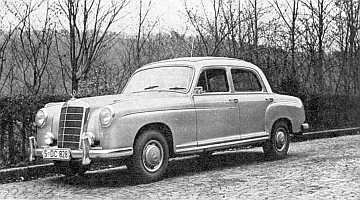
® The Mercedes -Benz 220 S (with Hydrak transmission) |
|
|
|
A Fast
and Exceptionally Roadworthy
Family Car with |
| THE Type 220 Mercedes-Benz was introduced in 1951 as the first medium-sized 6-cylinder car to be sold by the factory since the war. Then fitted into the traditional Mercedes-Benz tubular frame, the o.h. camshaft engine developed 79 b.h.p. which sufficed to drive the car at 89 m.p.h.; to raise the speed to 60 m.p.h. from rest in 19i seconds, and to give an overall fuel consumption of 19 m.p.g. In 1955 the concept of the car was radically revised although there was no change in type number. The tubular frame was displaced by a unit body and chassis construction, the classic type of swing axle replaced by the single-joint low-pivot type (which has subsequently become standardized throughout the Stuttgart range of cars); and the engine output raised to 85 b.h.p. Simultaneously the exterior shape was transformed and the interior body space and luggage-carry-
In Brief |
ing capacity considerably increased although the weight was reduced from 26½ to 26 cwt. Maximum speed was raised to 941 m.p.h., the rest to 60 m.p.h. time lowered to 15 seconds and the fuel con- sumption improved to 21 m.p.g. In July of this year 220S was announced and the engine output, thanks to the use of two compound type carburetters, a compres- sion ratio of 8.7:1 and a new camshaft, is now 100 b.h.p., and a vacuum servo braking system in conjunction with light alloy front brake drums is standard. As an optional extra the car can be had with a folding roof which gives almost all the advantages of a full convertible and as an alternative to the normal transmis- sion system the Hydrak gear can be fitted. This consists of a fluid coupling built into the flywheel to give easy starting and a vacuum controlled single-plate clutch that makes possible easy gear-changes without a clutch pedal. The car recently tested by The Motor enjoyed both these optional extras and at first sight looked too large and too heavy to offer acceptable performance from so relatively small an engine. With a wheel- base of 9 ft. 3 in. and an overall length of nearly 15} feet the car is certainly not a small one and this is reflected in a body which has an internal width of no less than 57 inches and not less than 9 inches leg room for the rear seat passengers even when the separate front seats are back almost to the limit. It is thus surprising that the kerb weight is no more than 26 cwt. but even so with a top gear offering practically 18 m.p.h. per 1,000 r.p.m. a sparkling performance |
on top gear cannot be expected. In fact, perhaps due to the new camshaft, the direct drive acceleration times recorded were slightly inferior to those offered on the equivalent 1955 model but with the fluid flywheel it is easily possible to start in top gear on level ground and to acceler- ate smoothly on full throttle up to the maximum speed of the car. There is then transmission slip up to nearly 30 m.p.h., so that this procedure must be condemned from the viewpoints of both performance and economy, and if the full cross-country performance of the car is to be maintained comparatively free use must be made of at least three out of the four synchronized ratios in the gearbox. Hand-operated Clutch For these reasons the behaviour of the Hydrak gear-changing system and the influence it has on the acceleration of the car are matters of prime importance. When the driver touches the end of the sensitized gear lever the friction clutch is withdrawn and the synchronizing cones permit a quiet change into an upper or a lower ratio. When the hand is removed from the gear lever the clutch comes home in a controlled fashion so as to give a smooth transition from one gear to another but during this process there is no inter- lock between the gear lever and throttle and the driver must, therefore, remember to release pressure on the accelerator pedal when changing up. It is also possible to improve the shift process by adding engine speed during the course of the downward change. |